An upright walker can help you walk with your forearms supported rather than leaning forward over traditional handles. The right fit matters: armrest height, frame stability, and wheel design can make a noticeable difference in everyday use.
These 10 listings cover seated, folding, and larger-wheel options. Some appear to be duplicate or closely related listings, so compare specifications before assuming each represents a distinct model.
Best 10 Upright Walker for Seniors Picks for 2026
Blue Travel Pick
Foldable Upright Walker With Seat

- 22 pounds; 300-pound capacity
- Adjustable handles and height
- Seat, backrest, footrests, and bag
Best For: Adjustable seated support that folds for storage or travel
Black Adjustable Pick

- 22 pounds; 300-pound capacity
- Three handle-length and five height settings
- Seat, backrest, footrests, and bag
Best For: A black foldable rollator with adjustable upright support
Rubber-Tire Pick
Helavo Upright Walker With Seat

- 10-inch rubber front wheels
- Padded armrests and cushioned seat
- 300-pound capacity; two-year warranty
Best For: Outdoor outings with padded support and a place to rest
Broad-Fit Pick
ELENKER All-Terrain Upright Rollator

- Stated fit: 4'8" to 6'4"
- 10-inch puncture-proof PU wheels
- 30 pounds; verify conflicting capacity figures
Best For: Adjustable forearm support across a broad stated user-height range
Outdoor Comfort Pick
Helavo Upright Walker with Rubber Tires

- 10-inch rubber front wheels
- Padded armrests and cushioned seat
- 22.7 lb frame; 300 lb capacity
Best For: Cushioned outdoor walks with seated breaks
Adjustable Fit Pick

- Adjustable forearm, handlebar, and leg tubes
- Padded seat and backrest
- One-hand fold; 27 lb weight
Best For: Adjustable fit with a padded resting spot
Lighter-Frame Pick

- 20 lb folding aluminum frame
- Forward-and-back adjustable forearm pads
- 17.5-inch-wide seat; 300 lb capacity
Best For: Easier lifting and adjustable arm support
Best for Everyday Essentials
ELENKER Adjustable Upright Rollator (Blue)
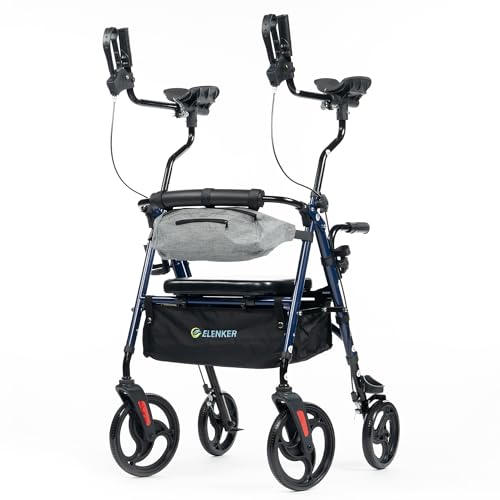
- Adjusts handlebar and seat height
- Padded seat and backrest
- Multiple storage and accessory holders
Best For: Daily outings with essentials close at hand
Best for Taller Users
Vive Mobility Folding Upright Walker

- Stated fit range: 5'2"–6'4"
- 20-pound folding aluminum frame
- Adjustable forearm pads and handgrips
Best For: Taller users who need a foldable rollator
Best Bright-Color Option
ELENKER Adjustable Upright Rollator (Orange)

- Adjustable frame and cushioned armrests
- Padded seat with storage options
- Verify conflicting listed height figures
Best For: Buyers who prefer orange and want padded seating
Blue Travel Pick – Foldable Upright Walker With Seat
This blue upright walker for seniors pairs forearm support with a seat for rest breaks. It weighs 22 pounds, folds to a listed 5.3-inch width, and supports up to 300 pounds.
Best For: Shoppers who want an adjustable upright rollator with a seat that folds for storage or travel.
Pros:
- Three handle-length and five height settings help tailor the fit.
- Includes a 20.5-by-9.8-inch seat, breathable backrest, footrests, and storage bag.
- 9.5-inch anti-slip wheels and hand brakes support controlled walking and stopping.
Cons:
- At 22 pounds, it may still take effort to lift into a vehicle.
- The listed folded length is 39 inches, so check your available storage space.
Its adjustability and included resting features make it a practical option if comfort matters as much as foldability. Confirm the handle-height range suits the intended user before buying.
Black Adjustable Pick – Foldable Upright Rollator
This black upright walker for seniors offers a seat, armrests, and a folding frame in a 22-pound package. Its listed handle adjustments and 300-pound capacity make it worth considering when fit and resting options are priorities.
Best For: Someone seeking a black, foldable upright rollator with multiple adjustments and a built-in seat.
Pros:
- Offers three handle-length settings and five height settings.
- Includes a 20.5-by-9.8-inch seat, breathable backrest, footrests, and storage bag.
- 9.5-inch anti-slip wheels pair with a braking system.
Cons:
- Its 22-pound weight may be cumbersome for users who need to lift it frequently.
- The supplied dimensions differ between the product bullets and details; verify folded size before purchase.
Choose this version if you prefer black and want the listed seat and fit options. Double-check overall dimensions and adjustment range against the user’s measurements.
Rubber-Tire Pick – Helavo Upright Walker With Seat
For shoppers comparing an upright walker for seniors for outdoor use, the Helavo stands out for its 10-inch front wheels and puncture-proof rubber tires. Padded armrests, adjustable handles, and a cushioned seat add support and a place to pause.
Best For: Users who want an upright rollator with rubber tires, padded support, and a seat for outdoor outings.
Pros:
- 10-inch rubber front wheels provide cushioning without the risk of a flat tire.
- Includes padded armrests, an adjustable backrest, and a cushioned seat.
- Comes with a cup holder, cane holder, parking brake, and two-year warranty.
Cons:
- At 22.7 pounds, it is not effortless to lift.
- The seat is listed at 18.9 inches wide and 9.1 inches deep; check whether that fits the user.
The rubber tires and included accessories make this a well-equipped choice for walks beyond the house. Its frame supports up to 300 pounds, but seat dimensions and overall width deserve a check before ordering.
Broad-Fit Pick – ELENKER All-Terrain Upright Rollator
This ELENKER upright walker for seniors lists a user-height range of 4 feet 8 inches to 6 feet 4 inches. Its 10-inch PU wheels, adjustable padded armrests, and cushioned seat suit shoppers who want upright support on varied walking surfaces.
Best For: Users seeking a broad stated height range, adjustable forearm support, and puncture-proof wheels.
Pros:
- 10-inch PU wheels require no inflation and are described as puncture-proof.
- Armrest length and holding angle adjust for positioning.
- Includes a cushioned seat, storage basket, cane or umbrella holder, and parking handbrakes.
Cons:
- At a listed 30 pounds, it is heavier than the other walkers in this roundup.
- The supplied capacity figures conflict: bullets say 300 pounds, while details say 350 pounds. Confirm the rated limit before use.
Its adjustability and larger wheels are appealing for varied routes, but weight matters if the walker must be loaded into a car. Verify the weight rating and fit specifications with the seller before purchasing.
Outdoor Comfort Pick – Helavo Upright Walker with Rubber Tires
If you want an upright walker for seniors that can handle outdoor outings, this Helavo pairs padded forearm rests with puncture-proof rubber tires and 10-inch front wheels. It also has a cushioned seat for breaks along the way.
Best For: Seniors who prioritize cushioned outdoor rolling and a comfortable place to rest.
Pros:
- Rubber tires provide cushioning without the risk of a flat.
- Adjustable ergonomic handles and padded armrests support an upright walking position.
- Includes a padded backrest, cup holder, cane holder, and parking brake.
Cons:
- At 22.7 pounds, it may take effort to lift into a vehicle.
- The 9.1-inch-deep seat may feel shallow to some users.
Its outdoor-ready tires and rest features make it a practical choice if walking comfort matters more than minimizing lift weight. Check the seat dimensions before buying.
Adjustable Fit Pick – ELENKER Upright Walker
For shoppers comparing an upright walker for seniors with multiple fit adjustments, the ELENKER lets you adjust the forearm tubes, handlebars, and leg tubes. Its padded seat and backrest offer a spot to pause during outings.
Best For: Seniors who want more frame adjustments and a padded seat in a foldable rollator.
Pros:
- Forearm, handlebar, and leg-tube adjustments help tailor the fit.
- One-hand folding simplifies storage and transport.
- Under-seat pouch, cane or umbrella holder, and locking rear-wheel brakes add convenience.
Cons:
- At 27 pounds, it is the heaviest of these three walkers.
- Its 28-inch overall width deserves a doorway check.
This model makes sense when adjustability and seating are priorities. Measure your usual routes and consider whether you can comfortably lift its 27-pound frame.
Lighter-Frame Pick – Vive Mobility Upright Walker
If lifting weight is a key factor in choosing an upright walker for seniors, the Vive weighs 20 pounds and folds for storage or car trips. Its adjustable forearm pads and grips let users fine-tune their arm position.
Best For: Seniors who want a lighter folding rollator with adjustable arm support.
Pros:
- 20-pound aluminum frame supports up to 300 pounds.
- Forearm pads adjust forward and backward; grips adjust in length.
- Includes an approximately 17.5-inch-wide seat, loop brakes, and a detachable shoulder bag.
Cons:
- The listed ideal user-height range is 5 feet 2 inches to 6 feet 4 inches, so fit may be less suitable outside it.
- Its 32-inch depth is worth checking against available storage space.
The Vive stands out for its relatively low stated weight and arm-position adjustments. Confirm that its height range, seat width, and folded storage needs work for you.
Best for Everyday Essentials – ELENKER Adjustable Upright Rollator (Blue)
This upright walker for seniors pairs cushioned forearm supports with an adjustable frame for users approximately 5 to 6 feet tall. Its 10-inch treaded wheels, padded seat and backrest, and several storage options make it a practical choice for daily outings.
Best For: Shoppers who want adjustable support, a comfortable rest stop, and easy access to everyday items.
Pros:
- Handlebar height, seat height, and handgrip angle are adjustable.
- Sponge-padded seat and backrest offer a cushioned place to rest.
- Front zippered pouch, under-seat basket, cup holder, and cane holder keep essentials handy.
- 10-inch wheels have anti-slip tread.
Cons:
- At 26 pounds, it may take more effort to lift than the 20-pound Vive model.
- The stated user-height range is limited to 5 to 6 feet.
Choose this blue ELENKER model if storage and seating comfort matter as much as upright walking support. Check that its adjustment range suits the intended user before buying.
Best for Taller Users – Vive Mobility Folding Upright Walker
For shoppers comparing an upright walker for seniors, this Vive model stands out for its stated 5-foot-2-inch to 6-foot-4-inch user-height range and foldable aluminum frame. Adjustable forearm pads and handgrips help tailor the fit, while an integrated seat provides a place to pause.
Best For: Taller users who want an adjustable upright rollator that folds for transport or storage.
Pros:
- Handles adjust from 45 to 52 inches, with forearm pads that move forward and backward.
- Folds for storage and weighs 20 pounds.
- Includes a 17.5-inch-wide seat, detachable shoulder bag, and loop brakes that lock the wheels for seating.
- Eight-inch flat-free wheels eliminate the need to inflate tires.
Cons:
- Its stated fit range begins at 5 feet 2 inches, so it may not suit shorter users.
- Its 8-inch wheels are smaller than the 10-inch wheels on the listed ELENKER models.
The Vive is worth considering when a taller fit and a lighter, folding frame take priority. Confirm the handle and forearm adjustments feel comfortable for the person who will use it.
Best Bright-Color Option – ELENKER Adjustable Upright Rollator (Orange)
This orange upright walker for seniors offers cushioned armrests, 10-inch treaded wheels, and a sponge-padded seat and backrest. Its adjustable handlebar height, seat height, and handgrip angle are intended to accommodate users from 5 to 6 feet tall.
Best For: Buyers who prefer an orange rollator with adjustable support, padded seating, and built-in storage.
Pros:
- Adjustable frame includes handlebar height, seat height, and handgrip angle.
- Padded seat and backrest provide a cushioned resting spot.
- Front zippered pouch, under-seat basket, cup holder, and cane holder add carrying options.
- 10-inch wheels feature anti-slip tread.
Cons:
- Weighs 26 pounds, which may be cumbersome to lift.
- Supplied height specifications conflict: the stated user range is 5 to 6 feet, but a separate minimum-height field lists 60 inches alongside a 46-inch maximum.
This model has the same core features listed for the blue ELENKER option, with an orange finish. Because the supplied height figures are inconsistent, verify the adjustment range before purchasing.
How We Picked the Best Upright Walker for Seniors
We focused on the practical differences shown in the selected listings: adjustable armrests, seats, folding frames, wheel designs, and stated weight capacities. We also considered where each type is likely to be used, from smooth indoor floors to uneven outdoor paths. Several listings appear to repeat the same or closely related products; check the current seller listing, dimensions, and included accessories rather than treating every entry as a different walker. We have not independently tested these models, so verify important specifications before buying.
Quick Comparison
For mostly indoor use, prioritize a frame that fits through your doorways, turns comfortably in your rooms, and folds to fit your storage space. For sidewalks or mixed surfaces, look more closely at larger wheels and tires suited to the surfaces you encounter. If you need regular rest breaks, compare seat dimensions, backrest support, and how easily you can apply the parking brakes before sitting. A listed 300-pound capacity may be relevant for some buyers, but confirm the exact model’s rating and allow for anything carried on the walker.
Key Buying Factors for an Upright Walker for Seniors
Fit and Forearm Support
Check the manufacturer’s recommended user-height range and adjustable armrest height. Your forearms should rest comfortably on the supports without forcing your shoulders upward or your back forward. Confirm that the arm pads and hand grips can be positioned where you can steer and operate the brakes easily. If possible, try the walker with the shoes you normally wear.
Wheels, Brakes, and Seating
Wheel size alone does not determine outdoor performance: tire material, surface conditions, and your ability to control the frame also matter. Test whether the walker feels manageable over thresholds and on the paths you use. Brakes should be easy to squeeze and should lock securely for seated breaks. Before sitting, follow the manufacturer’s instructions, lock the brakes, and position the walker on firm, level ground.
Size, Weight, and Transport
Compare the walker’s overall width with your narrowest doorway and its folded dimensions with your car trunk or storage area. A lighter frame may be easier to lift, while a larger frame may offer more room at the seat. If someone else will load it into a vehicle, consider what they can lift comfortably, not just whether the walker folds.
Who Should Buy Which Upright Walker for Seniors?
Choose a compact folding option if indoor maneuverability and transport are your priorities. Consider a larger-wheel model if your usual routes include sidewalks or rougher paved areas, while checking that it still fits at home. Choose a model with a supportive seat and backrest if you expect frequent pauses. If balance, posture, or brake operation is a concern, ask a physical or occupational therapist to help assess fit and safe use; an upright walker is not a substitute for individualized mobility advice.